
 |
 |
 |
 |
|
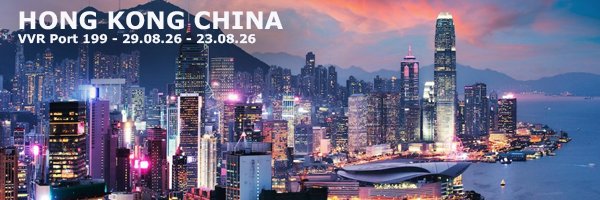
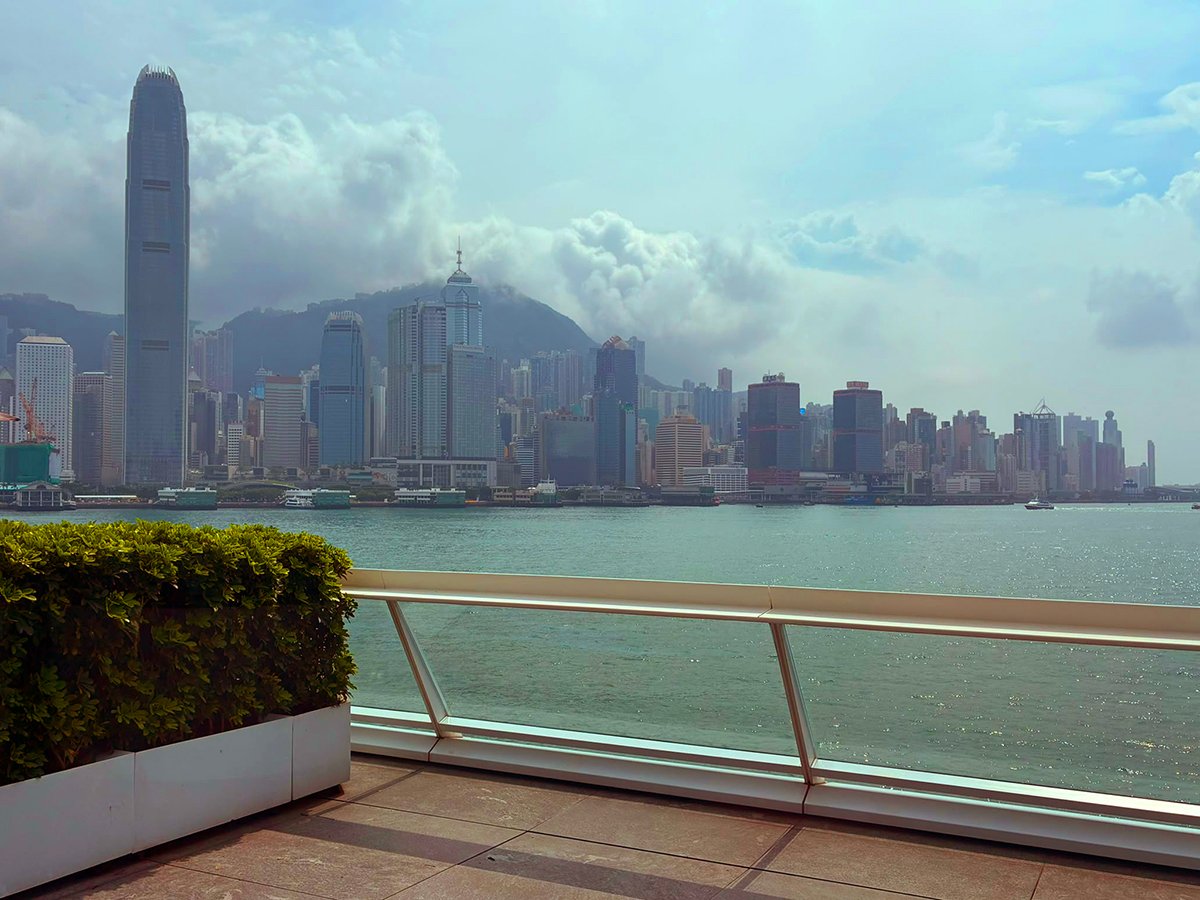
August 29-30, 2026 Marti Eicholz The Odyssey enters Victoria Harbour at dawn, where Hong Kong rises from mist, mountain, water, and light, briefly held, then already becoming memory. After three days at sea, after the ghostly limestone towers of Ha Long had slipped behind us like the last pages of a dream, the Odyssey turned toward Hong Kong. Before I could see the city, I could feel its soft, restless magnetism drawing us to the rails, the windows, the open decks where the wind tasted faintly of salt, metal, and rain. The sea widened into a polished blue-gray road. Then Hong Kong appeared as a suggestion in the haze, mountains shouldered upward, towers glittered at their feet, glass and cranes and ferries caught the morning light as though the harbor itself were learning how to speak. Hong Kong received us in motion and shimmer: ferries stitching pale seams across Victoria Harbour, buses breathing at curbs, signs glowing in English and Chinese, the whole city climbing from the water with the urgency of something born from rock and appetite. The Odyssey’s two-day stop held the ache of arrivals and departures. New passengers came aboard with luggage and bright expectation; others stepped away for visits, appointments, inland travel, or a private pause from ship life. Crew whose contracts had ended moved through the halls with the tender lightness of release. For a moment, the ship seemed to inhale and exhale, one floating body full of farewells, reunions, and beginnings. Hong Kong is famously vertical, but height was not what first pierced me. It was the rhythm of compression and release: towers pressed so close they seemed to share breath, then a sudden sweep of mountain green; neon and finance, then incense and stone; the metallic pulse of crossings, then the hush of harbor water against the quay. Victoria Harbour lay between Hong Kong Island and Kowloon like a polished lung, taking in ferries, weather, commerce, and memory. Geography felt theatrical and intimate at once. The mountains leaned toward the sea; the buildings rose like declarations; and the harbor held the whole drama in its reflective palm. The city’s urgency begins with its terrain. Hong Kong Island, Kowloon, the New Territories, and the outlying islands are folded into steep land, pressed against sea and rock. With so much of the land mountainous, Hong Kong learned to rise brilliantly: upward and inward, through hills, over roads, across water, and along passages threaded through impossible spaces. Yet the result is not merely density. It is elegance under pressure; skybridges, tunnels, escalators, ferries, trams, and walkways forming a second city above and beneath the visible one, as if daily life itself had learned to levitate. From the ship, Victoria Harbour felt less like water than a mirror with a pulse. Heat softened the skyline; marine haze blurred the towers until they seemed half-built from glass and half from weather. The Star Ferries crossed with an old-fashioned tenderness, small and steadfast amid sleeker vessels, as if they remembered every face ever turned toward the water. To arrive by sea is to understand the city at the level of the body: Hong Kong was a harbor before it was a skyline, a shelter before it became a spectacle, a place where the world came close enough to touch. On shore, the city moved quickly, but not carelessly. People flowed through MTR stations, malls, side streets, covered walkways, and ferry piers with the practiced grace of water finding its level. I found myself surrendering to the current: stand to one side, step forward, tap the card, make room, keep going. In a city of such closeness, movement becomes etiquette. To pass through without collision is its own small courtesy, a form of intimacy. The streets had their own music. Cantonese rose and fell in quick bright arcs; English appeared on tram stops and storefronts; Mandarin surfaced in announcements and passing conversation. The city did not feel like a version of “East meets West,” but something layered, lived-in, and sensuous. A Taoist temple could breathe incense beside a luxury window; a ritual older than the skyline could continue beneath a bank tower without apology. Hong Kong lets contradictions remain sharp and fragrant, tea and diesel, sandalwood and rain, polished marble and wet market stone, and that is its pulse. Food was everywhere, not as decoration but as devotion. Steam rose from bamboo baskets; roast meats gleamed lacquered and amber in shop windows; noodles, tea, custards, pineapple buns, and street snacks perfumed the city hour by hour. I loved the way appetite seemed woven into the civic fabric, practical and emotional. Eating felt like a language spoken with chopsticks, porcelain spoons, folded napkins, and shared tables: efficient, generous, precise, deeply tender. A meal was greeting, memory, family, argument, comfort, and proof that life, however crowded, still makes room for pleasure. Alongside the practical genius of transit cards, elevators, air-conditioned walkways, and financial systems, older beliefs still breathed close to the skin. Feng shui, ancestor offerings, temple smoke, lucky numbers, lion dances, and good-luck gestures did not feel like ornaments from the past; they felt like ways of touching uncertainty without flinching. Hong Kong can calculate and pray in the same hour. It can trade in global currencies and still pause before a coil of incense, watching smoke write its delicate alphabet into the air. Because land is so precious, Hong Kong teaches another intimacy between privacy and public life. Apartments may be small, but the city offers shared rooms everywhere: restaurants, parks, promenades, malls, markets, mountain paths, libraries, ferry decks. People live not only behind doors but across the city itself. A bench by the harbor becomes a front porch. A noodle shop becomes a dining room. A covered walkway becomes a neighborhood corridor. I found this unexpectedly moving, the way a city can press people close and still give them corners of belonging. The Central–Mid-Levels Escalator felt like the city’s emblem: an 800-metre (2600 feet) covered system of escalators and walkways lifting commuters and wanderers between Central and the steep residential slopes above. It was not built as romance, but it became romantic by accident. Riding it, I felt carried through the private weather of Hong Kong, past second-floor windows, cafés, laundries, bars, shrines, galleries, staircases, and glimpses of ordinary lives arranged vertically. The city brushed past my shoulder, close enough to smell coffee, rain, frying scallions, damp stone, perfume, and incense. For a little while, I was not walking through Hong Kong. Hong Kong was moving me through itself. The phrase “Lion Rock Spirit” stayed with me like a line from a song. It names perseverance, mutual support, and the will to build a better life through difficulty. Beneath the words I imagined crowded hillside homes, hands at work, families beginning again, ambition carried in lunch tins and schoolbags, a city learning to endure. Like all civic myths, it is part history, part longing. It remembers struggle but wakes each morning to climb. From our two days, I carried away most tenderly that: Hong Kong is endurance without self-pity, beauty without softness, velocity with a hidden heart. It does not ask to be admired only for its skyline. It simply continues; building, eating, hurrying, remembering, praying, trading, crossing water, climbing hills. At night, when the harbor lights came on and the towers became constellations of human effort, I stood looking back toward the Odyssey and felt the small ache of passing through. We had arrived, exchanged stories, welcomed strangers, said goodbye to others, and prepared to sail on. But the city remained behind us, bright and compressed, holding its mountains, its harbor, its hunger, its contradictions, its incense and glass, its rain-wet streets, and its astonishing will. For two days, Hong Kong opened itself like a fan; and when it closed again, something of its shimmer stayed in my hand. |
|
Copyright © 2026 All rights reserved |